
Chapter 1
What is Good?
What is your philosophy? I’ve asked this question of many people for many years. Few can say it clearly, but everyone has one. I was handed a philosophy I was expected to accept without question. For a long time, I did.
Definition of a Good Life
A philosophy is how we define and decide “What is Good?” Philosophers ask questions like “What is a Good Life?” and “How does one live a Good Life?”
The philosophy handed down to me was the definition of 20th-century success in the United States:
- Get good grades to get into a good college,
- Have a paper route to save money for college,
- Become an Eagle Scout to win a scholarship to pay for college,
- Study things in college to get a good job,
- Work 50 or 60 hours a week until you retire,
- Mow your grass, rake your leaves, save for retirement,
- Go to church every Sunday, thy will be done.
The paper route was the most dangerous time of my day. Every morning, from age 12 to 18, I got up at 6 am and delivered newspapers to 50 to 100 homes in my neighborhood. Every week, I’d get on my bicycle and collect hundreds of dollars of cash. They don’t even let kids have this job anymore. But that’s not why it was dangerous. It was dangerous because it gave me quiet time to think and watch glimpses of people’s lives. In my neighborhood, we all seemed to have been given similar philosophies. It felt like we were programmed to be this way. Geography is destiny, I thought.
Within one square mile of where I was born, I saw a narrow range of lifestyles. I saw very normal people, with very normal jobs, doing very normal things like raking leaves. As a teenager, I couldn’t imagine anything worse.
At 14, I started to add to my list of what it meant to have a Good Life:
~ Not having to rake your own leaves. ~
I decided then I would never rake my own leaves. In the meantime, I accepted the programming I was given, and I did what I was told. I got up every morning and delivered newspapers. I cut people’s lawns and raked their leaves. I did my homework, got straight A’s, and got scholarships to help pay for college. I graduated college in three years and started at General Electric in one of their “prestigious” engineering and management training programs.
I was rewarded with a cubicle in a windowless lab and...
~ I hated it from day one. ~
Whoops. This was Not Good, I thought. Now what?
[nothing] is an exploration of how we aim to live. It celebrates the fiftieth anniversary of Robert Pirsig’s classic Zen and the Art of Motorcycle Maintenance: An Inquiry into Values. That book opened with this epigraph:
“And what is good, Phaedrus, and what is not good—Need we ask anyone to tell us these things?”
I remembered the signs I had put on the wall of my college dorm – Birth, School, Work, Death – and this poem appeared.
Birth, School, Work, Death
A poem about the pointlessness of life in the machine
Chapter 2
What We Are Supposed To Do
Ilanded in a job I hated because I was supposed to land there. I was an electrical engineer working in a windowless lab in Syracuse, one of the most sunless city in America.
One February, the news said there were only 20 hours of sunshine in the entire month. I had to take their word for it. I didn’t see it. People need the sun, I thought.
My brother, Tom, had landed in the same spot seven years earlier and it seemed to be working for him. It wasn’t going to work for me. I could not do this five days a week, 50 weeks a year, for 40 years until I retired. This was Not Good. I had to get out.
Still, I got up and went to work the next day and the next. It was what I was supposed to do. Chop Wood, Carry Water1, I thought.
Being the Good Student, I read a lot of books to figure out what went wrong.
I read self-help books, business books, and philosophy books. Brave New World, 1984, What Color is Your Parachute? Think and Grow Rich, Do You Want to be a Lawyer? Seven Habits of Highly Effective People, Aristotle for Everybody, Sophie’s World, and so on.
It was then, in 1991, that I first read Zen and the Art of Motorcycle Maintenance: An Inquiry into Values by Robert Pirsig and his second book, Lila: An Inquiry into Morals. I filled them both with highlights, scribbles, and notes.
“The test of the machine is the satisfaction it gives you,” Pirsig wrote. “There isn’t any other test. If the machine produces tranquility, it’s right. If it disturbs you, it’s wrong until either the machine or your mind is changed.”
I re-read that line over and over.
If You’re Not Happy, Get Happy
At the time, I was living with my friend Pete Radosta in the top half of a 50-year-old house in a city neighborhood with big houses and wide streets.
Pete, or “Speedo” as we called him, was my Resident Advisor and next-door neighbor. He became a Resident Director, founded the Sigma Chi Fraternity and won our school’s highest honor - the Phalanx Leadership Award.
Speedo graduated a year before me, moved to Syracuse, and took a job at a well-respected engineering firm.
~ And his mom and dad thought it was Good. ~
One day, Speedo came home and said he was going to quit his job and move to Park City, Utah. I was confused. This was 1991. Working remotely was not an option. Most people had landlines. No one had cell phones.
“What are you going to do for work?” I asked.
“Ski Patrol,” Speedo said.
Ski Patrol?! With two words, he broke all the rules I’d been taught about life. “You’re not allowed to do that,” I thought. “You studied civil engineering, and you have a Good Job at a Good engineering firm. That is what you are supposed to do.”
As we packed up his U-Haul, I peppered him with questions. “What are you thinking? What about your career? What do your parents think?”
Speedo held up a finger, pausing my torrent of questions. The wind stopped, and the street got quiet. He put his hand on my shoulder and looked me in the eye and said,
“If you’re not happy, get happy.”
I was stunned. In the silence, Pirsig’s words echoed in my mind, “There isn’t any other test.”
As Speedo drove west, I thought about the path of my life. As the youngest of four children, I had followed my older brothers:
We all got paper routes, part-time jobs at restaurants, and went to college to get Good Jobs. It seemed Good for them. But for me, it was Not Good.
It was time to ask more questions.
I began questioning everything from the religion of my parents to the idea of retirement as a worthy goal.
If I Could Ask Any Question
Chapter 3
Existential Questions
After asking a lot of questions, I concluded an MBA was a more socially acceptable way to jump out of an airplane going somewhere I didn’t want to go. My brother had completed his MBA while working at GE, but I was finally going to be different and go full time.
While I was applying to business schools, my dad asked,
~ “Are you going to apply to Harvard?” ~
“No, Dad,” I snapped.
There was no way he could know what he was talking about. My dad spent one year at Saint John Fisher College before dropping out and becoming a sheet metal worker - a Good Union Job.
“Your name isn’t on any buildings,” I continued. “We don’t even know anyone who has ever visited there. There’s no way I’ll get in! It would be a waste of time and money to apply.”
My dad was used to my certainty. He thought about it for a minute. Then a wry smile lit up his face. “Ok, John, I’ll bet you $100 that you’ll get in.”
We grew up playing cards and gambling for money with family almost every week. Calculating odds was the most prized skill in our family, in life, and, by extension, in the world.
This bet didn’t require calculation. I had already written dozens of essays applying to other schools. A few more would be easy enough to slap together.
“Ok, Dad, you’re on.”
One of the essay questions was:
What Would I Do with a Harvard MBA
For the first time in my life, I had no brothers to follow. It was time to write my own story. I wrote:
“After graduating from Harvard Business School, I plan to work at a management consulting firm. I’d like to gain experience with a variety of companies rapidly. I believe that will provide a capstone of practical business experience after business school in the same way that the rotational program at GE did after college.
After that, I would like to experience buying and selling companies.
Then, I would get experience with starting and growing companies before starting a company on my own.
Ultimately, I plan to start and run my own company. I believe the experience and network I would gain by attending Harvard Business School, followed by the right set of experiences, would dramatically increase my likelihood of success.
After building my company, I would write a book and teach.
I lost the bet and moved to Boston. And Boston had the best weather I’d ever lived in.
Years later, I realized everything I wrote in that essay happened…in order.
How is that possible?
The only line that hadn’t yet happened was…that I would write a book.
~ So, I started writing. ~
Practical Philosophical Truth
Practical
An Unintentional Haiku by my father.
Philosophical
Inspired by a Russell Neese, a Comanche descendant
Truth
The “Boot Sequence” as explained by a friend
Chapter 4
How Do We Know What We Know?
In the first chapter of Lila, Pirsig described his system for writing. He had “four long card-catalog-type trays'' containing eleven thousand cards that he spent “four years organizing and reorganizing.”
I remember writing in the margins:
~ A system to pursue Quality. ~
My process was similar, if more electronic and less organized. Wherever I was, I wrote - mostly with no purpose or agenda. I imagined I was filling an appendix.
One of the memos I wrote in the appendix was, “People are like Sonar Systems.”
People are like Sonar Systems
On a family vacation in England visiting cousins, I walked around the Chithurst Monastery while Monks ate and swept in silence. I thought about rigid routines, practices, and beliefs, and how differently people see the world.
In the silence of the monastery grounds, I wondered: how do people know what to believe? How do they separate the signal from the noise?
As an electrical engineer in that windowless lab, I worked on a sonar system. A sonar does three things. It:
- Samples data from its environment,
- Separates the signal from the noise, and
- Creates a map of the territory.
People do the same. They:
- Gather data from their senses and stories they are told,
- Separate the signal from the noise according to a value system,
- Create a mental map, to determine what to pursue and how they should behave.
Signal and Noise
Chapter 5
These Thoughts in Your Head
Igrew up in Rochester, New York. My parents have been married for 64 years. They have four kids, 12 grandchildren, and 8 great-grandchildren. They and all their spouses live in or within driving distance of Rochester. I love my family, so, I live in San Diego.
One weekend, two of my seven nephews, Jeff Abrams and Phil Zdanowski, came to visit. Jeff is twenty years younger than me, and Phil is younger still.
I’m John. When I say “we” in this book, I mean Jeff and me. Jeff and I began working together when he graduated college. I was his mentor, now he is mine. We formed a business together in 2021 as equal partners. It isn’t easy for a mentor and mentee to become equals. As we were forming the partnership, Jeff said, “Do you know how valuable I am?”
I replied, “Do you want more than 50%?”
[nothing] is derived from the conversations we’ve had almost every day since. It is the philosophy of our partnership – how we aspire to operate in the world. We expect the system will evolve.
Phil was our first employee. He had been working at a CPA firm for four years. It was draining him. He worked for ungrateful clients who viewed audits as an expensive, useless, necessary evil.
Phil thought he would work hard and get promoted to manager in ten years, and then it would be Good. I told him, “That’s a terrible story, Phil. Stop telling yourself that story.”
~ I’d rather rake other people’s leaves. ~
Sipping iced tea and contemplating business and life with my nephews, I leaned toward Phil and said, “I used to think my thoughts were true.”
Phil was stunned. “You have to believe your thoughts are true! Don’t you? What are your thoughts to you?”
We laughed at the Dr. Seuss-like cadence of that exchange. I can’t think of anything better than sitting with my nephews for a weekend, sipping iced tea.
The Thinker & The Naught
A poem about consciousness and the contents of consciousness.2
Chapter 6
A Map of Things Inside Your Head
Despite 12 years of religious indoctrination as a child, I didn’t learn to meditate until I turned 50.
~ How come that’s not a sin? ~
They teach us all this stuff, but they don’t teach us how our minds work. It’s as if science doesn’t know either.
In guided meditations, we are asked to notice things that arise in consciousness and then fall away. Sam Harris calls these things the “Contents of Consciousness.”
Consciousness is the unchanging “naught” in which everything we experience appears. Whether the inputs come from our day-to-day life, or from the overlords in The Matrix, consciousness is the space where it all appears.
Venn Diagram: Consciousness and its Contents
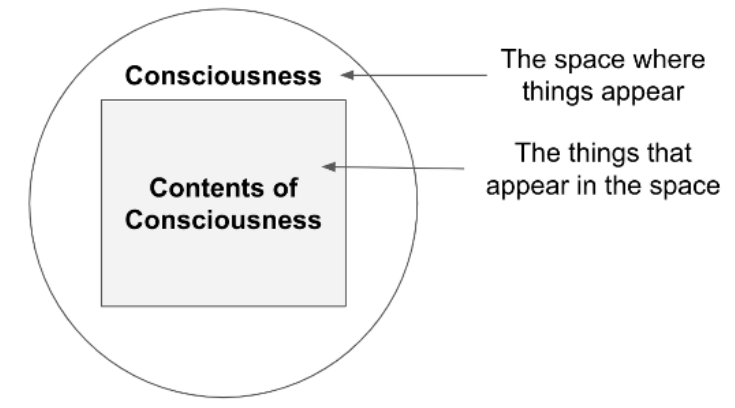
Meditation teachers prompt us, first, to notice our breath, then the sounds around us, then the thoughts in our heads. One of the things they teach you at Harvard Business School is how to think in 2x2s – so this picture appeared in my head.
The 2x2 of the Contents of Consciousness
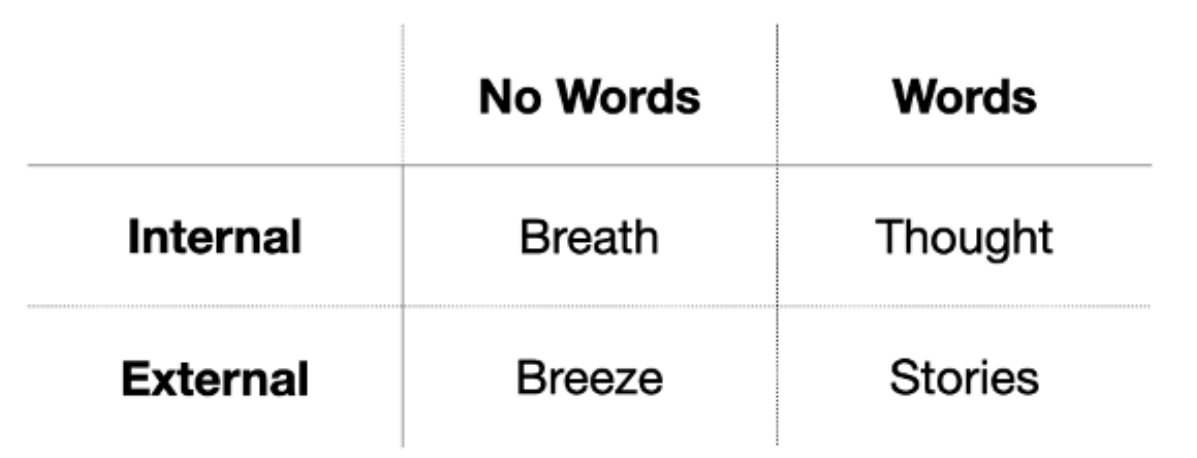
Everything that passes through consciousness falls into one of the four boxes: Breath, Breeze, Thought, and Stories. Consider how Breath and Thought are similar.
We can breathe fast or slow, or we can ignore it, and breathing still happens.
Thought is the same way. We can focus our attention on a subject and, maybe, write a sentence. Yet thoughts still form endlessly without effort.
Outside the body, Breeze stands for all the wordless things around us that we feel and that affect us. We have no control over them.
The line down the middle of the 2x2 is important. On the left of the line is life before words, and on the right is life after words. It's such an important line that it's one of the most famous lines in The Bible - “In the beginning was the Word.”
~ Why? ~
It's easy to forget the power of The Word that each of us thoughtlessly wields. Before words, nature’s ability to transmit information through generations was limited. When we acquired the ability to use words everything changed - a new beginning for the planet, and for humanity.
It's like we ate from the Tree of Knowledge.
Subtle Choice
A poem about choice in the Garden of Eden
Chapter 7
The Word is not The Thing
As the lack of sun sucked the life out of me in that windowless lab, I did appreciate GE’s Edison Engineering Program. The program was named after Thomas Edison, the founder of GE. I thanked God for the inventor of the light bulb – those were dark days.
Edison did something few people have ever done. Imagine founding a company and having it last over 100 years. Edison said,
“If we all did the things we are really capable of doing, we would literally astound ourselves.”
For part of the Edison program, we had to solve word problems related to the technologies underlying Radar and Sonar Systems. We wrote long-hand reports explaining complicated math with proper punctuation.
Words and Math Make Science
Mathematics is a precise form of language. When words and math combine to predict things, we call that science.
Different communities use different words - even within the same language. For example, one word I never heard before living in San Diego is “moment” as in “being in the…”
After learning to meditate, I was talking to a Lyft driver and naturally, the subject of “being in the moment” came up. He said, “Have you read this book?” He reached into his passenger seat and held up “The Wisdom of Insecurity,” by Alan Watts.
~ When the student is ready, the teacher will appear ~
I ordered the book immediately. It was my introduction to Alan Watts. Born in England, Alan Watts spent the 1960s living on a houseboat in Sausalito. I imagined there were no leaves to rake on a houseboat.
Watts was one of the first people to make Eastern philosophies accessible to Western audiences.
Since then, I’ve read and listened to much of his work. One of his speeches was set to music. It starts:
“I wonder, I wonder, what you would do… if you had the power to dream any dream you wanted to.”
Watts pointed me to another 20th-century philosopher, Alfred Korzybski. Born in Poland in the late 1800s, Korzybski followed his father’s instructions to become an engineer, like me. He emigrated to the US around the turn of the century and developed a branch of philosophy called General Semantics.
General Semantics is the study of how language and symbols influence human thought and behavior.
Korzybski coined the phrases “the map is not the territory” and “the word is not the thing.” These lines highlight how language can point at, but never fully express, reality.
In 1937, Korzybski gave a seminar series on General Semantics at Olivet College. As I read the lectures, I could feel myself sitting in the audience. It starts:
~ “To begin with, lose all fear.” ~
As I summarized it, this Not-a-Poem appeared.
Using Language Like Math
A poem about how language affects our perceptions
Chapter 8
The Art of Complicated Subjects
You’ve come a long way. Let’s rest here and look back.
We’ve covered:
- How a philosophy defines What is Good,
- That philosophies are handed down,
- How everything we do in our lives seems to start as a story in our heads,
- How we separate the signal from the noise and make a map of the territory to know what we know,
- The difference between consciousness and the contents of consciousness, and
- That the words we use and the stories we tell affect how we perceive the world.
We have braved philosophical territory, and we’re still hiking up the mountain. This is “the high country of the mind” as Pirsig called it. He said,
“Mountains should be climbed with as little effort as possible and without desire. The reality of your own nature should determine the speed. If you become restless, speed up. If you become winded, slow down. You climb the mountain in an equilibrium between restlessness and exhaustion.”
Zen and the Art of Motorcycle Maintenance is filled with insights like this. On the surface, it's a simple story. Robert Pirsig and his son, Chris, are on a motorcycle trip from Minneapolis through the Dakotas, Montana, and into the Pacific Northwest. Along the way, we learn how to care for a motorcycle on a long trip.
There’s a second storyline in the book that is more complicated. During the long motorcycle rides, Pirsig narrates the story of how his younger self, whom he calls Phaedrus, was committed to an insane asylum for seeing the world differently.
Pirsig calls his way of seeing the world the Metaphysics of Quality. Metaphysics is a way of slicing up the world so we can better understand it. Think of it as a “map” of reality. Pirsig said,
“We take a handful of sand from the endless landscape of awareness around us and call that handful of sand the world.”
A Metaphysics is a Map of Reality
Aristotle called metaphysics the first philosophy. Aristotle's first slice of reality was between subjects and objects. According to that slice, each of us is a subject who experiences the objects in the world. Aristotle’s metaphysics is the one we all commonly understand. All of Western science and thought rests on this first slice.
~ Pirsig sliced the world differently ~
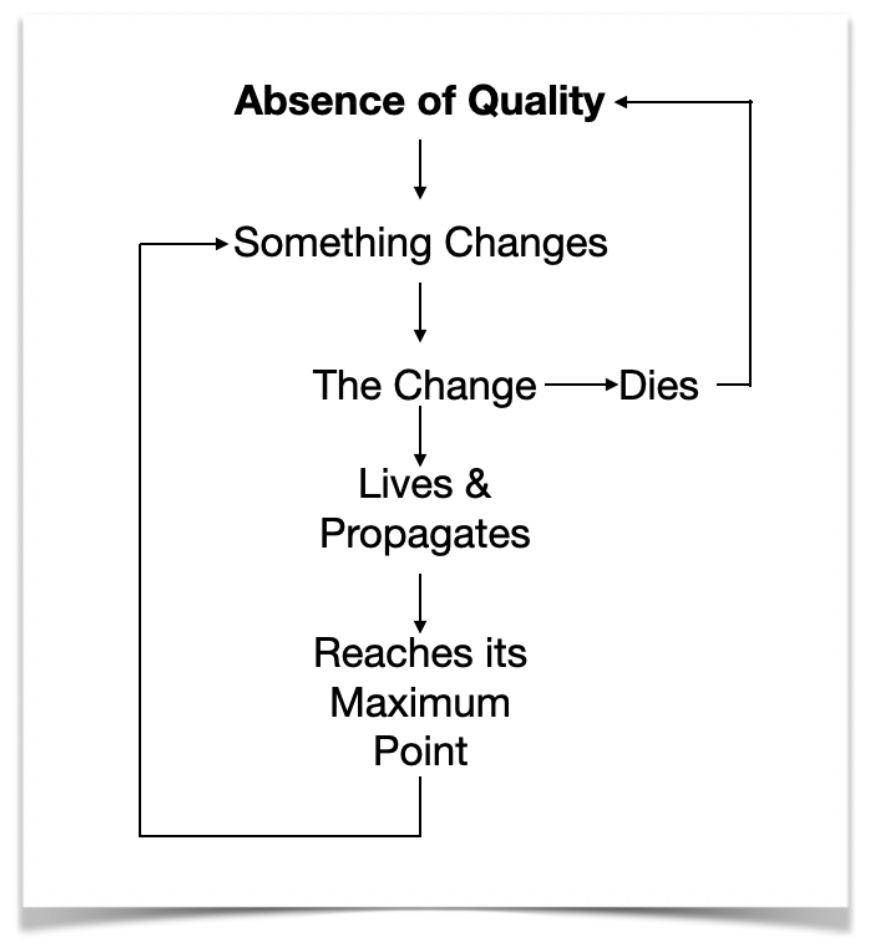
Instead of fixed subjects and objects, Pirsig describes a world in constant flux, trending toward Quality. He describes four levels of change, each building on the other, with different characteristics and timescales.
At the base level of Pirsig’s Quality is Inorganic Quality – the Earth. Just above that is Organic Quality, as in life on Earth. Just above that is Cultural Quality, as in the way living organisms organize themselves. At the top is Intellectual Quality: all the ideas and patterns of thought we have about the world.
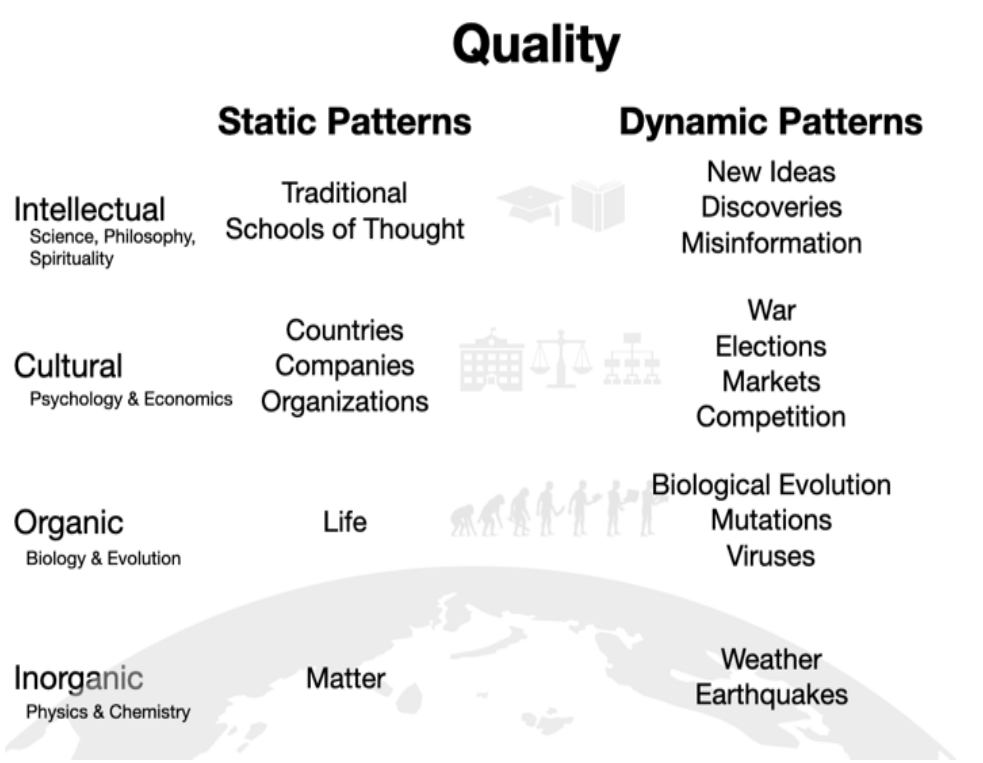
Each of these levels of Quality is split into Static Patterns and Dynamic Patterns. For example, DNA is a Static Pattern of Quality, and a mutation is a Dynamic one.
In this language, Science is a Static Pattern of Intellectual Quality. New ideas - like the Earth being round, or not being the center of the universe – are rejected as crazy before they are accepted as science. In Lila, Pirsig said:
“Without Dynamic Quality, the organism cannot grow. Without Static Quality the organism cannot last. Both are needed.”
While considering a world without Quality, Pirsig wrote:
“Poetry would disappear, since it seldom makes sense and has no practical value.”
Like this one:
Evolution
A poem about Pirsig’s Metaphysics of Quality.
Chapter 9
Meta-What?
Metaphysics is a big word, and that makes it sound like a complicated subject. When big words and complicated subjects come up, you can almost hear people’s brains click off.
~ Click ~
Complicated subjects have been institutionalized in what Pirsig calls the Church of Reason – educational institutions that certify people with degrees. They mostly teach
~ Static Patterns of Intellectual Quality. ~
When a new idea appears, especially one that cuts across disciplines, it’s hard for institutionalized people to see it. Often, they see the people who think differently as a threat, and they institutionalize them to maintain the status quo.
Installing a Cultural Story
People in institutions of higher learning form priesthood. Many of these priesthoods were formed around beliefs etched in stone before anyone knew the Earth circles the sun.
Schools pass the stories approved by priesthoods and politicians on to children, by rote.
Lessons Passed Through Generations
We memorize dates, events, people, and stories important to our country's founding. We learn about the challenges people before us faced and overcame. This is how countries pass on and preserve the stories of their culture.
Between Control and Chaos
Different cultural systems bubble up and disappear. A few persist. People struggle for resources within their cultural systems and when systems clash.
New technologies and new ideas change cultures. Better systems inevitably proliferate or reach a tenuous balance of cultural market share.
Status quo is an illusion. Everything changes.
The Histomap of World History4
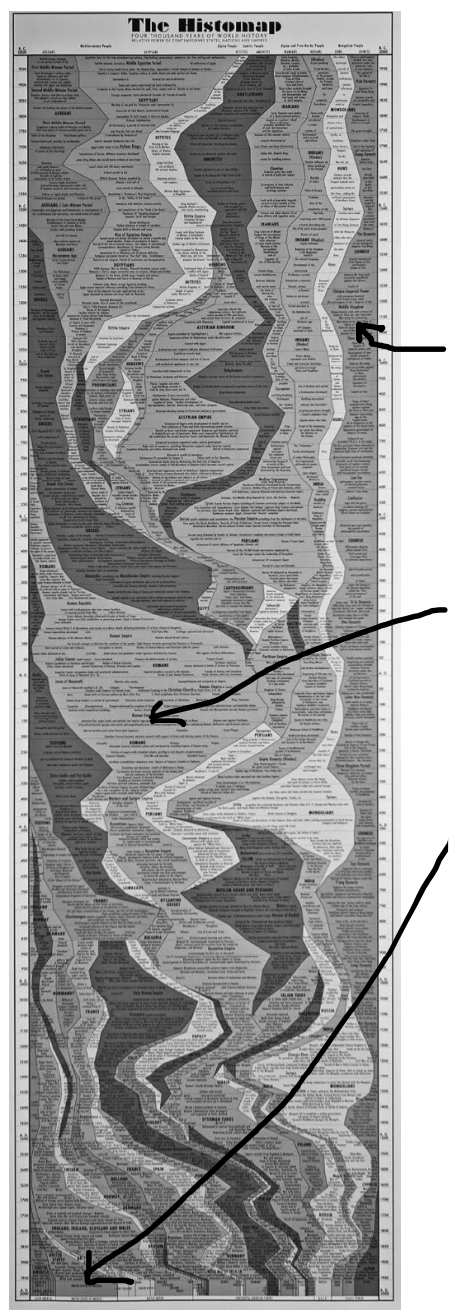
The Histomap is a view of history that shows how different cultural systems bubble up and disappear.
Shrunk to fit this book, three things are notable.
- China is the only unbroken chain. It stretches from the top right of the poster all the way to the bottom right. No other country has persisted as it has for as long.
- The big bubble in the middle of the poster is the Roman Empire. No other cultural story has ever dominated the world as much.
- The United States appears in the last bit of the poster on the lower left. Its barely visible.
From this perspective it’s easier to see that society is a ceaseless dance between control and chaos. What Pirsig called “Static Quality” and “Dynamic Quality.”
It usually takes a Brujo - an outcast – to change things. Sometimes it’s just the idea of someone outside the institution driving change.
Consider an idea as simple as wearing helmets when we ski.
From Cracked Skulls to Crazy People
When I first learned to ski, nobody wore a helmet. If you saw a person wearing a helmet, you might think they had a cracked skull.
Today, everyone wears a helmet. If you see someone not wearing a helmet, you might think they need to have their head examined.
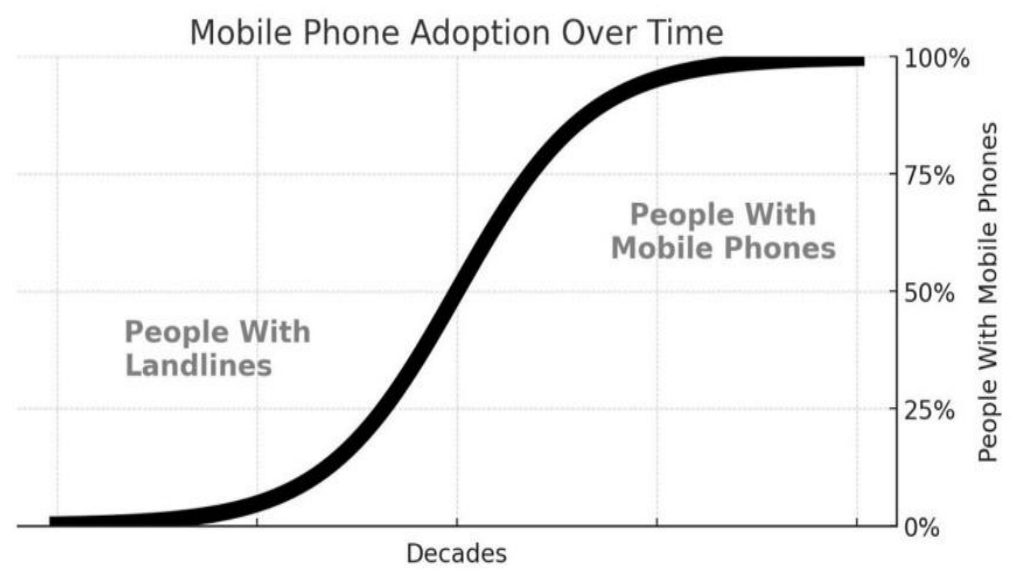
If you plotted the percentage of people wearing a helmet from then until now, it would look like this:
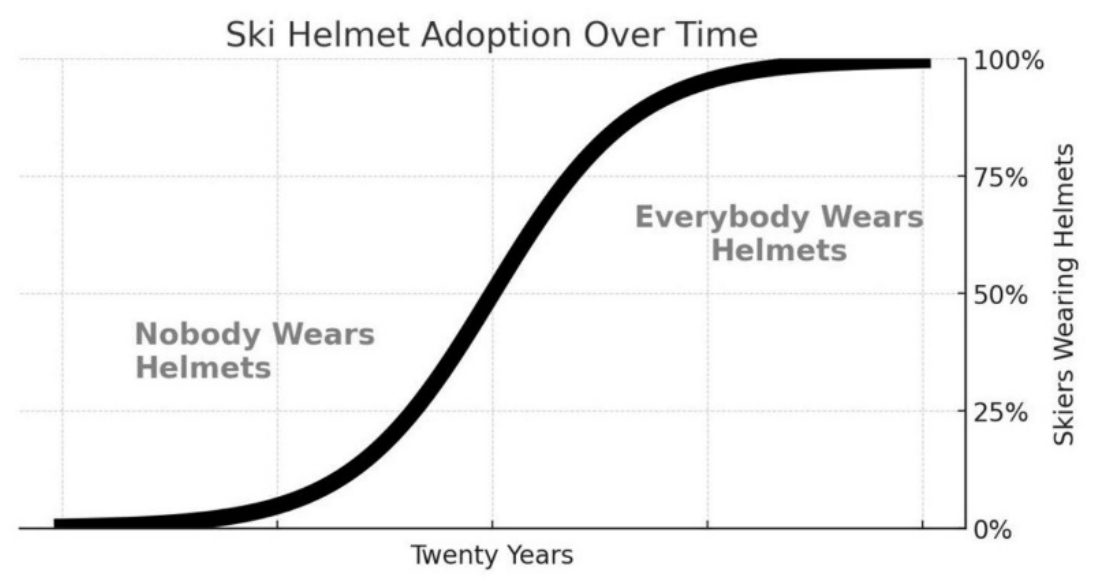
In 1997 and 1998, a few famous people – Sonny Bono, Michael Kennedy – broke their skulls on trees, and now nearly everybody wears helmets.
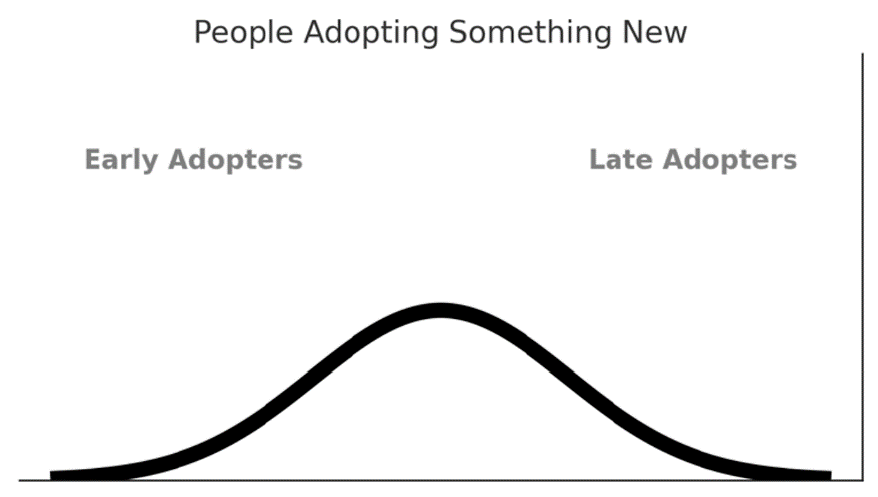
How Systems Evolve
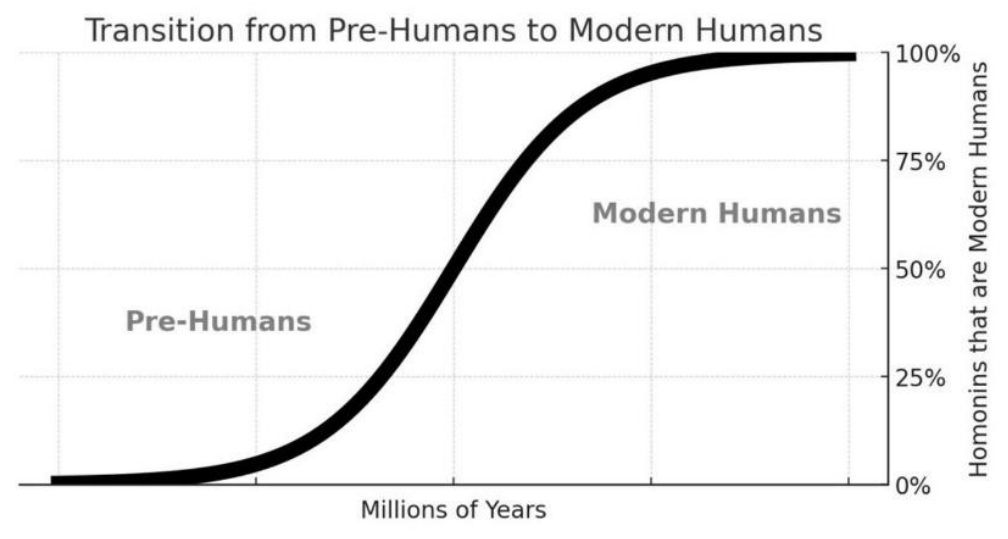
Such change across populations is common. There have been early and late adopters of every new idea and technology.
We see it in the decades of transition from landlines to cell phones.
We see it in the eons-long transition from early humans to Homo sapiens.
The same goes for housing, running water, sanitation systems, electricity, color televisions, cable televisions, and the Internet. There was a time before everything in our lives. Something appears and changes everything.
~ Click ~
That Click
A poem about the moment an idea breaks loose
Chapter 10
How Ideas Proliferate
Some ideas and some stories are labeled “divinely inspired.” We are told that a single founder had a special connection to the divine that you don’t have, and you can never have.
There are stories like this in every culture. Before Jesus, there was no Christianity. Before Mohammad, no Islam.
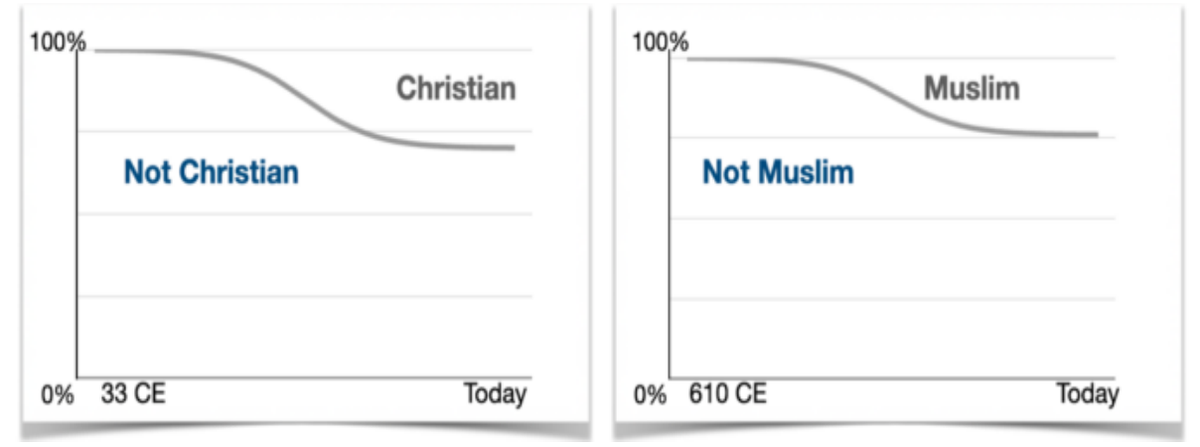
A Tenuous Balance of Cultural Market Share
Religious systems spread along the same curve – early adopters and late adopters. Religions never reach 100% of the population. They reach a tenuous balance of cultural market share.
These stories were written down in holy books centuries ago and can no longer be edited or even questioned.
I wondered: what makes a book a bible?
Not-a-Bible
Chapter 11
The Religion of Startups
Let’s back away from religion and move to something I’m a little more qualified to talk about - startups.
A Startup Religion
Since business school, I’ve spent most of my career working with founders and startups. When change driven by the Internet rippled through an industry, I was there. I was attracted by big visions and, as the CFO, I fixed the unit economics.
I worked with computer companies, copier companies, phone companies, and toy companies. I helped build internet service providers, web hosting companies, and data centers. I took two companies public and helped manage the digital economy of the largest virtual world – Second Life – before Bitcoin.
More recently, the team and I have worked with companies driving change in the US education and healthcare systems.
We also invented a way to lend money against the inventory of emerging consumer brands based on their business data from platforms like Shopify. We called it Assembled Brands.
Along the way, we’ve heard plenty of founders tell crazy stories of growth and innovation that never materialized
The Spectrum of Founder Delusion
While a few of these founders might feel a spiritual connection to their mission and express it with religious zeal, none would claim to have a more special connection with the divine than you or me.
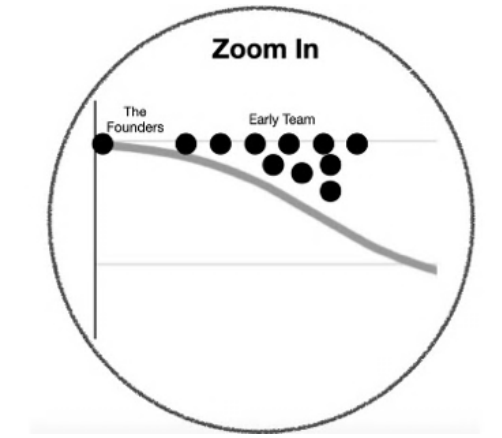
Founders of startups - be they startup companies, startup schools, startup governments, or startup religions - rely on the ones who come before them.
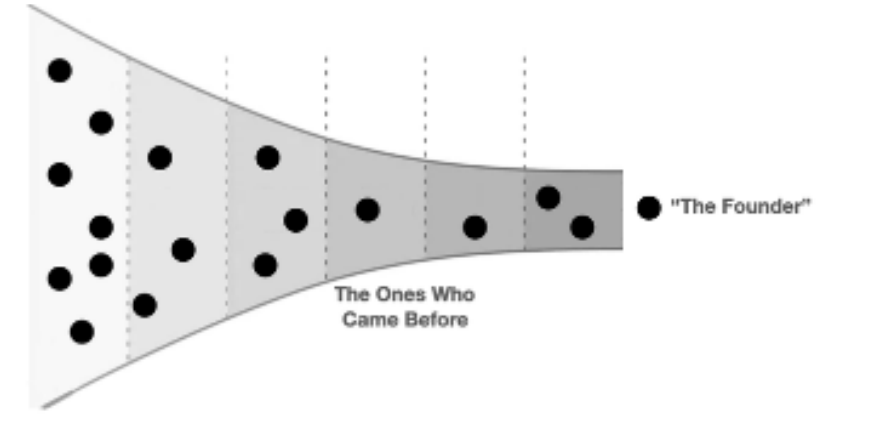
Founders must recruit others to grow their stories. The early team and investors act like apostles to help the founder tell their stories.
A Little System
Chapter 12
A Big Vision Story
One Saturday, while we were building Assembled Brands, Trevor, the head of growth, came to my house for the day. We spent the day and evening in what might best be called as an entheogenic strategy and coaching session.
Trevor was six-foot-four, 35 and a brilliant growth hacker. He overflowed with confidence and positivity.
At one point, he asked, “What do you tell yourself when you wake up in the morning?”
Grief and anxiety filled my head.
I laughed uncomfortably and told him, “I usually think things like ‘I drank too much last night. I stayed up too late. I devoured the rest of the ice cream. I have a stomachache.’” Organic anxiety, I thought.
I continued. “Did I say something stupid yesterday? I wonder who I texted at 2 am? Is that deal going to close?” Social anxiety, I thought.
Trevor scrunched his face in disapproval.
“Those are stupid stories, John. Stop telling yourself those stories,” he said.
We moved from my office, my mancave, to sit under the large Ficus tree in my backyard that I call the Zodhi tree.
As we walked, a matrix of Anxiety and Depression based on the structure of the Metaphysics of Quality appeared in my head.
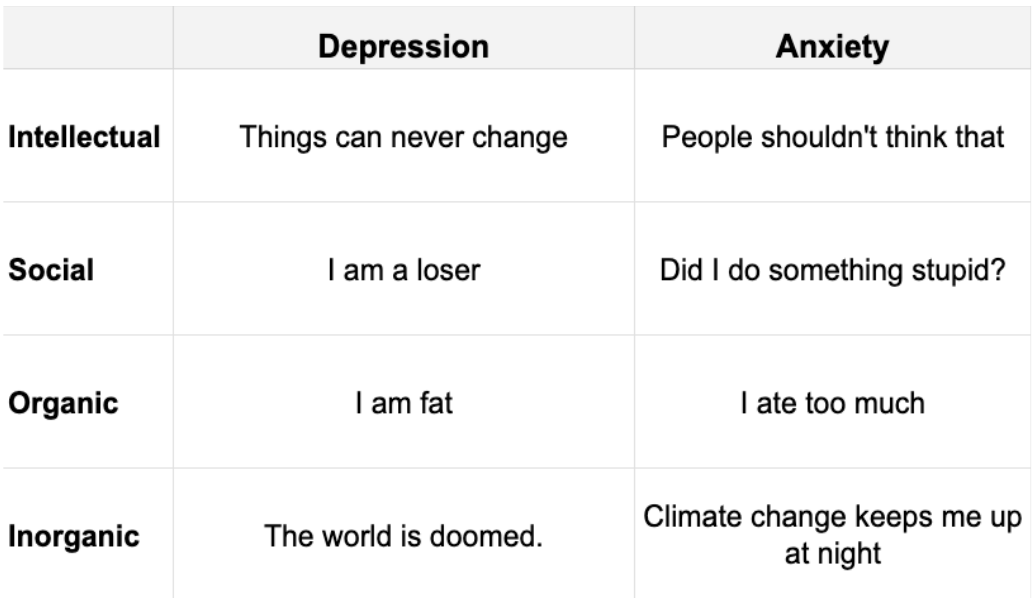
Anxiety is a desire for something to be different than it is. Depression is a belief that things can never change. Both lead to despair.
Despair
Introducing the Boot Sequence
When we sat down under the tree, Trevor continued his point dismissing my anxieties, “Do you know what a Boot Sequence is?” he asked.
“Do you mean like the Apple logo that appears on my phone when I turn it on?” I asked.
“Yes, that logo is part of the device’s boot sequence. The device turns on, and a small set of code gets loaded from long-term storage into live memory and processed to tell the device who it is supposed to do.”
I could see where he was heading. My anxieties are my boot sequence. I wake up and remind myself of all the problems I have and what I dread most.
Trevor was getting animated, “Think about it, John. Everything you have ever done started with a story in your head. Going to college, buying a car, getting a job, getting married. It all started with an idea you, or someone else, put in your head.”
Trevor was saying I could put a different set of code - a different story - into my long-term storage that would reprogram how I saw and behaved in the world. Like Speedo and his U-Haul, I thought.
“So, every morning,” Trevor said, “I say my boot sequence out loud:
“You actually do this?” I asked.
“Yes, every day,” he said.
Just as we all have a philosophy, we all have a boot sequence, whether we realize it or not.
The Stories We Are Told to Tell
I reflected on the boot sequences I’d been indoctrinated with. Remember the definition of a Good Life that was handed down to me? Like my brothers, I was told that to get into a Good College I had to become a Boy Scout and earn the rank of Eagle Scout.
Every Scout had to memorize and repeat the Scout Oath:
“On my honor, I will do my best to do my duty to God and my country, to obey the Scout Law, to help other people at all times, to keep myself physically strong, mentally awake, and morally straight.”
~ It's like a boot sequence for a Boy Scout. ~
The Scout Law is similar:
“A scout is trustworthy, loyal, helpful, friendly, courteous, kind, obedient, cheerful, thrifty, brave, clean, and reverent.”
~ Forty years later, I still know them by heart ~
As schoolchildren in the 1970s, every day, we’d recite the Pledge of Allegiance:
I pledge allegiance to The Flag of The United States of America, and to The Republic for which it stands. One nation, under God, with liberty and justice for all.
~ Ritual and repetition bind people together. ~
The boot sequences we’re told to memorize state the values a community shares:
- Gratitude
- Respect
- Acceptance
- Forgiveness
- Awareness, and
- Confidence
Writing Your Own Boot Sequence
We can install, on purpose, new assumptions about the world in our heads. These repeated intentions go deep into our subconscious and affect how we see what is happening around us. The boot sequence doesn't bend reality, it retunes attention, which changes what you notice and do.
~ They don’t teach this in school. ~
But since I had somehow projected my entire life in my Harvard Business School essay 33 years ago, I began to wonder if a boot sequence might actually work.
Boot Sequences as Big Visions
After explaining the boot sequence, Trevor told me he had bought the domain name Conscious.ly. We brainstormed a big vision for that domain.
As an apostle of a series of founders, I have always been attracted to Big Visions. Trevor and I sat there discussing some of the ones I loved.
- Second Life’s - “To connect everyone to an online world that improves the human condition.”
- General Assembly’s - “A global community of individuals empowered to pursue the work they love.”
Say what you want about Elon Musk these days, but it's hard not to love:
- Tesla’s - “To accelerate humanity's transition to sustainable energy.”
For Conscious.ly, we simply changed a few words of Tesla’s:
“Conscious.ly’s mission is to accelerate humanity's evolution to the next level of consciousness,” we laughed. No one could do that, right?
Then we turned to something more practical for our company at the time, Assembled Brands: “To reinvent venture financing for the 21st century.”
I elaborated. “Because as consumers become more aware of where their products come from and where they go, every single product in every single category needs to be reinvented. The incumbent financial system is not set up to finance so many small companies.”
If we were going to change the world by helping brands grow, I had to change myself first. As Confucius said:
“First, there must be order and harmony within your own mind. Then this order will spread to your family, then to the community, and finally to your entire kingdom. Only then can you have peace and harmony.”
Later I drafted the rest of my boot sequence:
Today is the Best Day Ever
My favorite line comes from Trevor’s:
I am so happy and grateful that money keeps coming to me in increasing quantities from multiple sources on a continuous basis.
Back then, all my income came from one company. Today, it comes from over 400.
Since everything in that essay had come true except the book, I ended my boot sequence with:
I am a writer.
Chapter 13
Philosofathergizing
I was walking the dogs around the neighborhood one golden afternoon when Luke, my 14-year-old son, sped by on his One Wheel. “I got 100 on my math test!” He held out his hand for a high five. His voice bent with the Doppler effect as he passed.
“I’m so proud of you, Luke, well done!” I said. As he zoomed away, I thought about how sometimes, when Luke is doing his math homework, he gets agitated when he makes a mistake or can’t figure something out. He groans out loud and complains about having so much more math to do - a trait he likely got from my younger self.
“Hey Luke, your grades are always going to be good enough…” he zoomed back toward me, as I continued, “...whether or not you resist any of the activities that you must do to get good grades. Just notice what your mindset is, and your grades are going to be fine.”
He looked puzzled, so I simplified: “I am not worried about your grades.”
Luke stopped right in front of me. “What are you worried about, Dad?” he asked.
I paused, realizing I’d fallen into a semantic trap. “I am not worried about anything, really. I just wish somebody had told me what I’m about to tell you.”
I had Luke’s attention. This had better be good, I thought. I had no idea what I was going to say.
Pirsig called it gumption – what fills you when you connect with Quality. Pirsig wrote:
“A person filled with gumption doesn’t sit around…stewing about things.”
I put my hand on Luke’s shoulder and looked him in the eye. “Your mindset while you're doing the work is more important than the outcome.”
“Can you remind me of that?” I started to say it again. “Your mindset while you are doing the work…”
“No, Dad,” Luke interrupted, firing up his One Wheel. “Saying it once, it's not going to change anything,” he said. “Repeating it to me now isn’t going to change anything. But after I hear it a bunch of times over a long period of time, I might start to get it.”
As he sped away, I smiled and thought, wow, Luke. I turned toward the setting sun and laughed out loud. “That’s exactly right!” I shouted after him.
Repeating a story to yourself over a long period of time is what people, organizations, companies, religions, and countries do.
It’s what they have always done.
Song of Metaphysics
Changing What You Value Changes the System
Back to Speedo and his U-Haul, plus Pirsig and his machine.
~ “If you’re not happy, get happy.” ~
Like a motorcycle, life is a system that must be tuned and re-tuned. Today, your life is 100% the way it is.
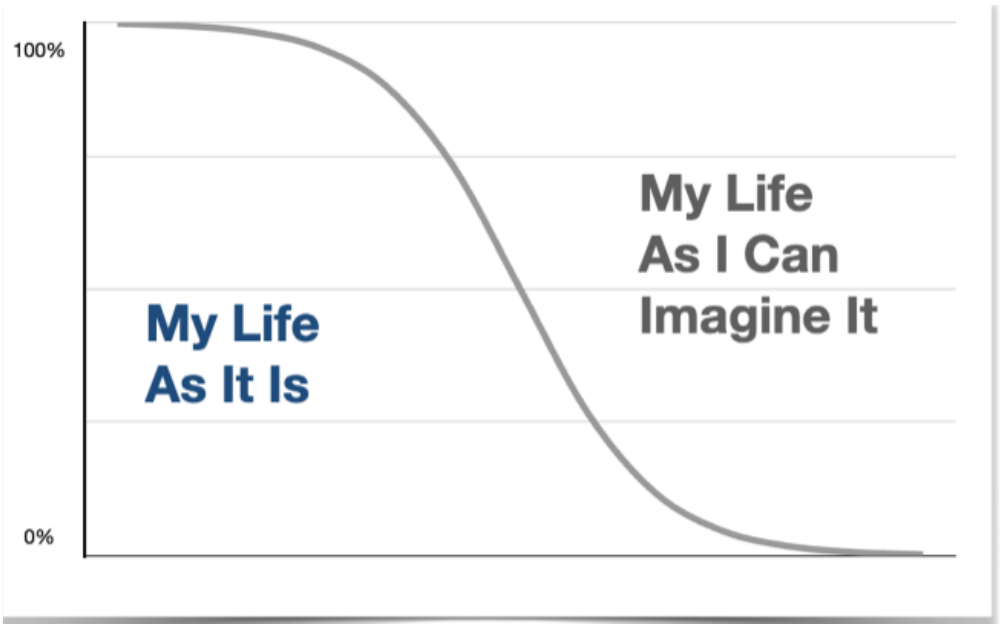
Everything you’ve ever accomplished started as an intention put in your head by you or someone else.
Your parents influence you initially, then teachers and friends. Eventually, each of us can become the narrator of our own epic story.
I wasn’t taught this as a young man. I am not claiming to be any better at this than anyone else. I wrestle with these ideas every day.
I’m just a kid who grew up inside a traditional philosophy, and then noticed how much my entire life was shaped by a story I wrote to Harvard Business School 33 years ago.
I didn’t realize my narrative imagination blossomed then. Yet it was Trevor’s boot sequence that brought the reins of my life from my unconscious to my conscious mind.
I didn’t write anything new until I added “I am a writer” to my boot sequence.
“I’ve always thought that each person invented himself… that we are each a figment of our own imagination. And some people have a greater ability to imagine than others.”
- David Geffen
Sunlight on my Eyelids
A poem about the story in your head
Chapter 14
The Story of Weekly Accounting
It took about four years to grow Assembled Brands from an idea to a funded team of a dozen with a path to profit.
Today, Assembled Brands has invested nearly $200 million in over 100 emerging consumer brands.
I’m still on the board, still on the credit committee, and with my team, still act as their CFO. But I stepped back to about an hour a week.
I left because, after looking at the financials of thousands of emerging consumer brands, we realized how poorly accountants and bookkeepers serve small businesses and we saw another huge business opportunity.
~ An opportunity to help a lot more people. ~
A New Story
As I stepped back from Assembled Brands, Jeff and I began to set the intentions of our partnership.
Jeff started by asking: “How do you want your day to be?”
I said, “All The Work would be done for me!”
Oops, I didn’t mean to spring that poem on you, but when you’ve got 100 poems explaining your philosophy, it happens. I can feel Luke, and the rest of my family, rolling their eyes at me. “Oh, Dad.” Pirsig said,
“When you’ve got a Chautauqua in your head, it’s extremely hard not to inflict it on innocent people.”
Next, we set a big vision – Weekly Accounting
To help everyone see their business better.
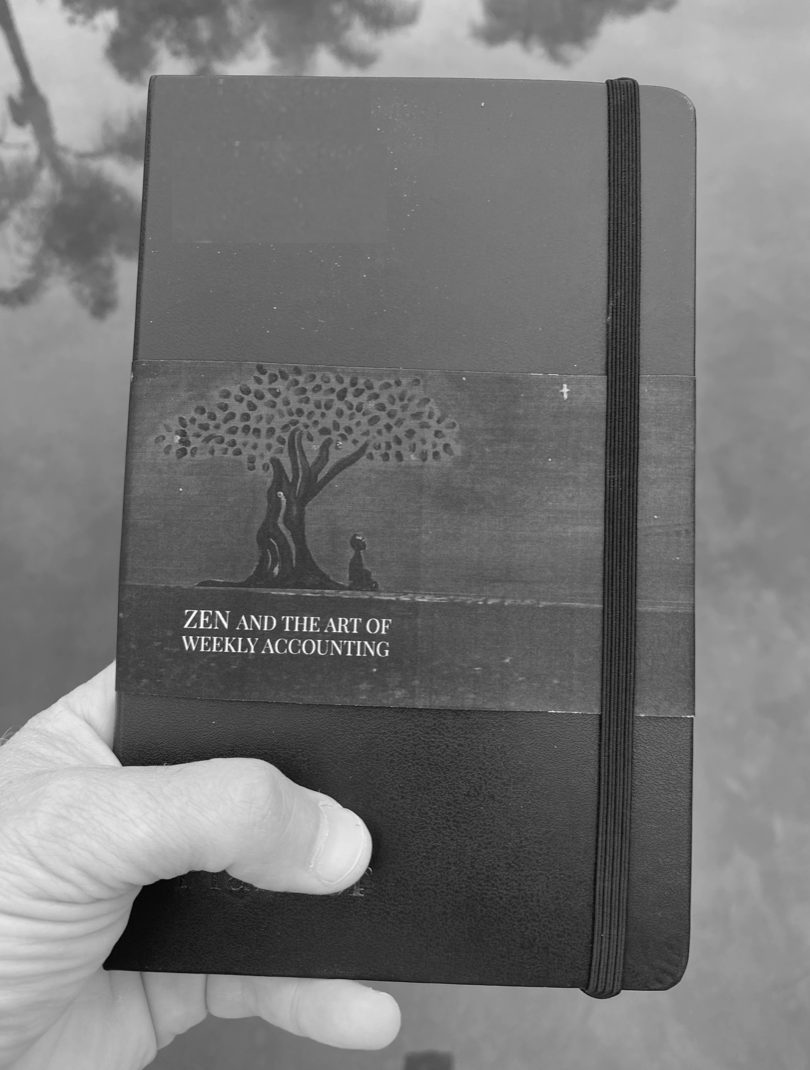
To do that, we developed a better map, one that uses all the data from the business, not just the bank transactions.
Here we introduce a new language and a new map. Consider this a preview of a second book. That second book, Zen and the Art of Weekly Accounting, is what I had intended to write when I wrapped an empty notebook with a reprint of a painting my daughter made.
A Map from the Time of Columbus
The traditional map of business is called the “Three Statement Model.” Its three statements are the income statement, the cash flow statement, and the balance sheet.
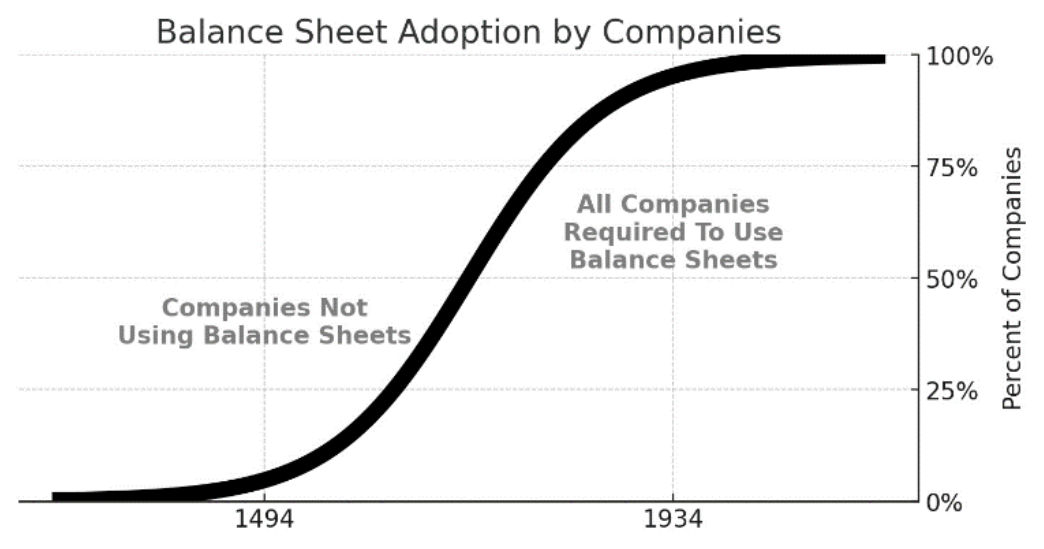
This map was first documented by Luca Pacioli, a friend of Leonardo da Vinci, in Venice, Italy in 1494 - over five hundred years ago. Columbus had just reached the Americas.
Balance sheets, like cell phones and ski helmets, must have been adopted slowly. Today, everyone uses them.
For 500 years, all accountants have done is make more rules. I thought:
~ A CPA is a license to do your books in a way that doesn’t help the business ~
A CPA’s job is to keep you compliant - to make sure you follow the rules of tax collectors and regulators.
~ A multi-hundred-billion-dollar industry to make sure you follow the rules. ~
I’d rather work in a windowless lab and go home and rake my own leaves than make sure people follow the rules of an arcane system designed 500 years ago.
I don’t mean to knock accountants. Most care and do great work—important work—and they get a lot right. It’s this system of audited financials that has enabled investors to put so much trust - and therefore investment – in public companies in the United States.
But though I’ve been a public company CFO, I was never taught how to think like an accountant. I am an electrical engineer used to working on Sonar Systems - so we started with a different intention.
Our intention was to help you see your business better.
Accountants have been so distracted by making sure you follow the rules that in those 500 years no one thought to double-click on revenue to see something that was common across all businesses in every industry. To cut through the jargon of industries to find a common view of revenue metrics and unit economics.
It's hard enough to explain a balance sheet to someone today. Imagine what it must have been like in 1494. And now imagine you’re seeing the fourth statement for the first time. As you read what follows, imagine the specifics in your own business.
The Fourth Statement: The Statement of Economic Quality
What’s great about an income statement, balance sheet and cash flow statement is that they give a common view across all businesses. You know what to expect when you are looking at financial statements - Revenue, COGs, Gross Profit, etc.
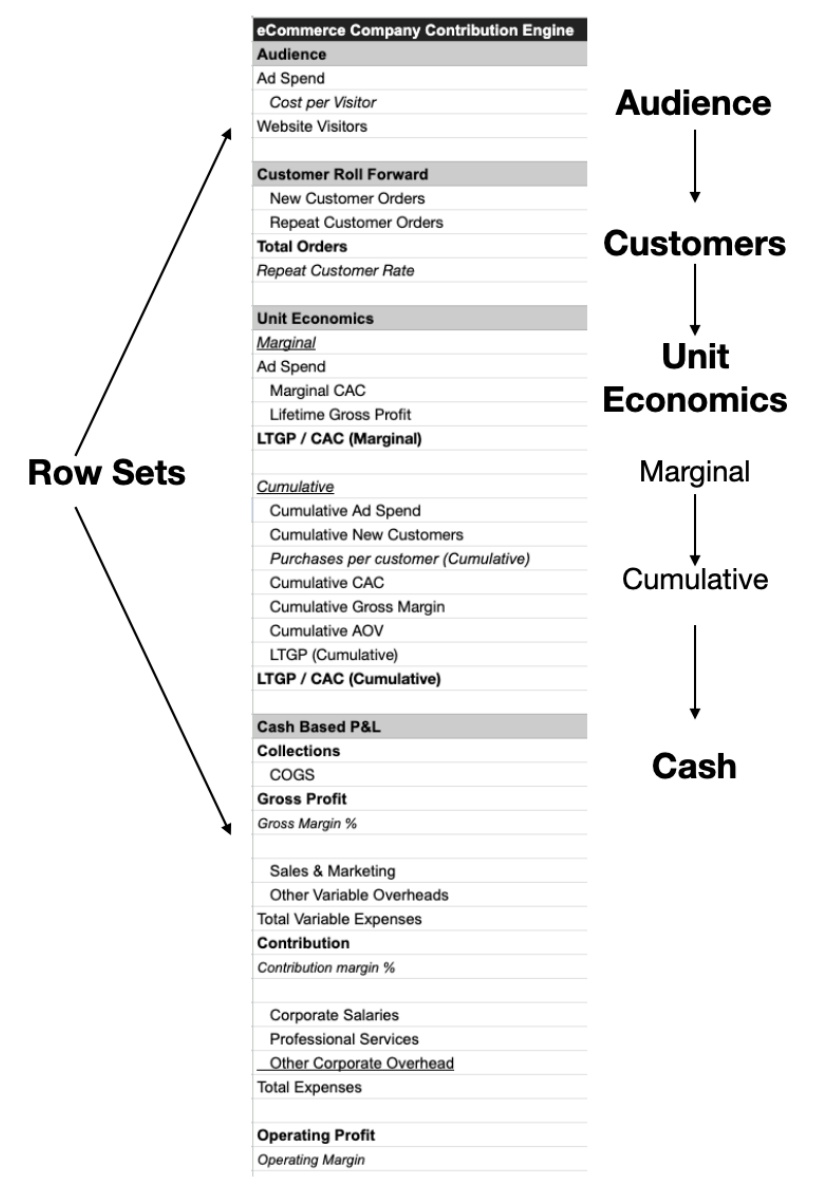
Like the first three financial statements, the fourth statement - the Statement of Economic Quality – is common across all businesses. It instruments the Contribution Engine and has four sections:
- The Audience section,
- The Customer Roll Forward section,
- The Unit Economics section, and
- The Direct Cash section.
The Income Statement answers the questions “Were we profitable over a period of time?” The Balance Sheet answers, “Where are all of our assets and liabilities at this specific point in time?” The Statement of Cash Flows answers, “Where did the cash come from and where did it go?” The Statement of Economic Quality answers,
“Are the underlying economics of the business healthy?”
Now, let’s look at each section of the Statement of Economic Quality more closely.
- Audience: Every company has a potential audience - its addressable market. Each period – we like weekly – the company spends money to reach a portion of its audience.
- Customer Roll Forward: Through a marketing funnel and sometimes a sales funnel, a company seeks to convert that audience into new customers and hopefully keep them coming back.
- Unit Economics: From those two sections, we can calculate a company’s Unit Economics. Unit Economics compare customer acquisition costs to the lifetime gross profit a customer is expected to generate. We sample unit economics over time - weekly, monthly and quarterly - but we also step back and look at Cumulative Unit Economics. We use the cumulative unit economics to compare the value of revenue streams in different industries.
- Direct Cash Flow Statement: Finally, we look at cash - through the lens of what Accountants call a Direct Cash Flow Statement. This starts with collections and ends with your change in cash without any accrual adjustments. Like looking at your own checkbook. We do it this way so we can close the books on a company quickly - every week in fact.
A map is “better” when it reflects the underlying nature of the territory it represents. Drawing on all of a business’s data can create a better map than one just from the transactions that hit the bank account.
We know it's a better map because it helps people make their businesses better. The reason is a simple 2x2:
~ When you put the right data in front of an empowered team, they get better. ~
You can try it other ways, but it won’t work.
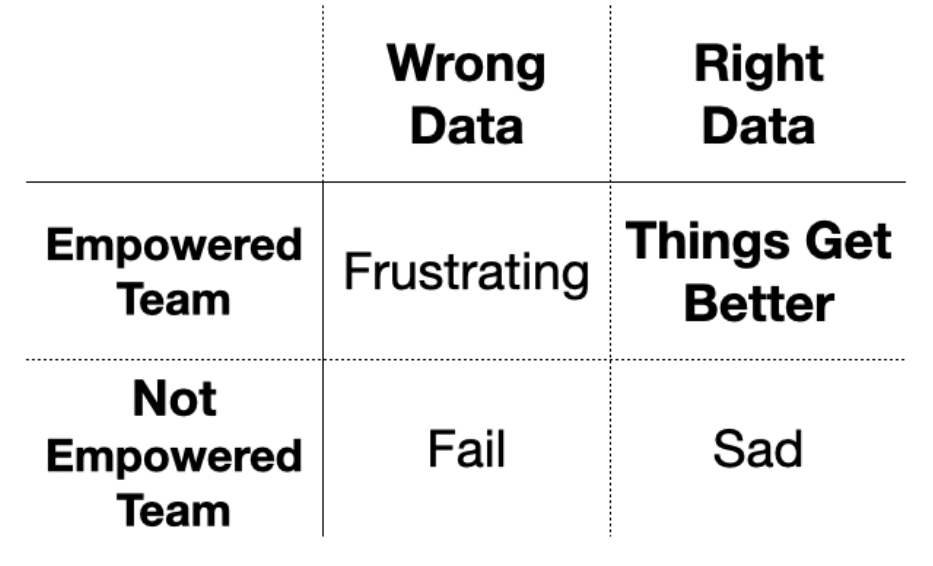
Often, you’ll try it other ways without knowing. You’ll be looking at the wrong data without knowing that it's wrong. You’ll get frustrated, or you’ll disempower your team – and that's just sad.
But here’s the thing - like everything else - it's a process. You start this process of improvement by admitting you have a problem. The map you are using isn’t getting you to where you want to go. That’s the “Test of the System.”
If it's not good, you ask more questions and gather more data to try to make a map that reflects the underlying reality better.
The Fourth Statement, The Statement of Economic Quality, illuminates the Contribution Engine of a business. When you use the right map to organize the data, the territory becomes clearer and it gets easier to get from one place to another. Once you see your business this way, you won’t be able to unsee it.
Let’s look at each part of the organization and how the language of the Contribution Engine can align everyone.
A new org chart
A business is a system with two kinds of people:
People working in the Contribution Engine and people working on the Contribution Engine. People working in the Contribution Engine are people who:
- Service customers directly, and
- Attract and retain customers.
The people working on the Contribution Engine are like the Pit Crew that maintains the components of the car as it circles the race track over and over, week after week. People working on the Contribution Engine are people who:
- Instrument the Contribution Engine,
- Finance the Contribution Engine,
- Staff the Contribution Engine, and
- Oversee the system as a whole - like the CEO, board and investors.
When you organize a business around the Contribution Engine, it’s easier to make the unit of work self-aware and align everyone to its goals.
We’ll have a lot more to say about this in our next book, Zen and the Art of Weekly Accounting.
eCommerce Company Contribution Engine
 Tap to enlarge
The Weekly Accounting Performance Matrix
Troubled
Data QualityTraditional Monthly Close done by a CPA
Feels like"We won't know revenue until we close the books"
Functional
Data QualityManual Monday Morning Metrics (MMM)
Feels like"Where'd you get that data? Is that right?"
Integrated
Data QualityAutomated MMM
Feels like"We know where to focus our attention"
World Class
Data Quality"Unit of Work" is "Self Aware"
Feels like"Every role has a set of weekly metrics to manage themselves by"
The Intention and the System
A poem based on a quotation by Robert Pirsig
Chapter 15
A System to Pursue Quality
Robert Pirsig wrote, “Metaphysics is good if it improves everyday life; otherwise forget it.”
I found that funny because though his books were successful, his metaphysics did not improve the everyday lives of many people.
Our understanding of the Metaphysics of Quality, combined with other stories passed to us through generations of storytellers inside and outside our families, has improved our everyday lives.
~ But I think Pirsig just planted a seed. ~
What else could he do?
He could see that universities in 1974 were teaching from a bad map. So, he wrote, and he wrote. He wrote about his experience, his thought process, years and years of dead ends, and the “gumption” it took to persevere.
He cared. He cared so much he spent his life writing down a different way of looking at the world, hoping it would one day improve everyday life.
When I was reading his books, I wrote in the margins:
“Pirsig wrote his books for students he would never meet.”
Pirsig threw an intellectual football deep into the future. With this work, we caught it, and now we’re throwing it on.
A System to Pursue Quality
Our intention is to build a system so that the most important work in the Metaphysics of Quality keeps being regenerated, generation after generation.
That’s what we hope [nothing] does.
Books are traditionally static. This is Not-a-Book. Bibles are especially static. This is Not-a-Bible.
I realize now that I am not doing this alone. I am not doing this for me. I have everything I need, and I have less time to live than I have lived.
I am doing this for my children and my children’s children. So that they can live in a world where people create Quality.
Today, people seem to create separation and isolation, and that creates despair. I think it’s because of the stories we tell and the stories we’ve been told. These stories, passed through generations, create the status quo.
To Increase our Responsibility
Long before we started our partnership, Jeff stated his intention: “To increase our responsibility.”
Until just now, I didn’t realize what that meant.
We stand in front of those who came before us. We honor our ancestors and the spirit of the land they cultivated and built upon to make our lives easier than theirs.
Our responsibility is to learn and pass on ideas and things that will help the future us, and our children and their children, to survive and thrive.
Zen and the Art of [nothing] is a seed crystal for a system that is fundamental to Our Premise:
If the stories we tell create the reality we see
And systems work better than goals
Then build a system to build systems
And practice better storytelling
Besides describing the Metaphysics of Quality, Pirsig’s books described a system to pursue Quality.
We’ve applied his philosophy and his system to create [nothing] - book zero of an infinite series. Motorcycle Maintenance and Lila are books one and two. Book three, our next book, will explore Weekly Accounting and the New Map for Business.
We put [nothing] in brackets because it's a placeholder for your art. The [art] of your life. Sooner or later, you’ll realize you are the narrator of your own epic story.
To get started, take an empty notebook and write an intention. Leave room to edit it. Then start writing.
Not-a-Book
Appendix
Our Ethos
- We believe the stories we tell create the reality we see
- We believe Big Visions and Positive Unit Economics can change the world
- We believe Systems work better than goals
- We seek Win-Win relationships
- We always bring data to the conversation
- We do it for fun
- We believe in the Spirit of the Gift
- We are so happy and grateful that we are so happy and grateful
- Our pronouns are “We” and “Our” because We are One
- Today is the Best Day Ever.
The Gardening Tips
- Notice the path you walk each day
- Express delight. Show empathy. Never criticize. It’s not the plant’s fault. It’s your fault.
- Instrument a few critical metrics – start with the pH of your water
- Try things, repeat what works
- Seek expert advice – we should have put this one sooner
- Don’t give up because you’re not an expert – it’s just for fun
- Be discerning with your attention. It’s easy to try too hard for too long
- Keep planting seeds
- Bigger gardens need more help
- Pruning is the art
- Make the path delightful for yourself
- You are going to get better at it
Acknowledgements
I don’t think you can intend to write a book like this. It seemed to evolve as soon as I added “I am a writer” to the boot sequence.
We are grateful to Trevor for teaching us the boot sequence. To Brian Swichkow for developing Mythos and teaching us to write in it. To Adam Pritzker for including us in the 100-Year Philosophy of Assembled Brands.
We are grateful to all the founders of companies we’ve worked with along the way, especially John McIntyre, a friend and business partner for 30 years, to Nikesh Parekh and Ian Morris for the first real CFO job and to Philip Rosedale and Ginsu Yoon for the second.
We are grateful to the thought partners who have come alongside us as we wrote this story, especially Jake Schwartz, and Greg Moser.
We are grateful to our partners in Weekly Accounting who have navigated a rapidly growing business with us including Phil Zdanowski, Kendra Edelman Smith, Sam Kaplan and Ari Gordon. We are grateful to all the people who have allowed us to practice the poetry on them. We are thankful to John McKusick for the cover design. It is the most beautiful part of the book.
And finally, we are grateful to our families for forgiving us for not actually being the voice that we sound like in our writing. We do keep getting better at it.
John Zdanowski & Jeff Abrams, June 2024.
Tomorrow Let it Be
If you enjoy this book, please email me at z@weeklyaccounting.com